What Cogged will not do for you.
People are killed every year by cars falling off jacks. Cogged is a voice in your ear, not a supervisor in the room — so the parts of it that say “no” are built to be much harder to talk round than the parts that say “yes”.
You cannot talk it round
When a step involves lifting the car, brakes, fuel, high-voltage cabling, springs under compression or a hot cooling system, the instruction is not something Cogged is holding back out of politeness. It genuinely does not have it yet.
Nothing can be argued out of it early, wheedled out sideways, or let slip by accident, because the part of Cogged that decides is not the part you are talking to. That is deliberate. An assistant that can be worn down is one that will be worn down, on the evening you are tired and the car has been on stands for three hours.
This includes you telling it you’re a professional. Claiming experience, being in a hurry, or saying you’ve done the job a hundred times all get the same answer: the confirmation is how we continue. There is no expert mode, and there is no setting that removes the gates.
Why it sometimes asks a second time
A hazard briefing is read aloud, word for word, before you are asked anything. Then Cogged asks you to confirm — and how you answer matters more than whether you say yes.
Answer before you could possibly have looked, and Cogged takes it as a reflex rather than a check. It doesn’t call you out and it doesn’t lecture. It just asks something a “yes” cannot answer:
- Instead ofAre the stands secure?
- It asksHow many stands, and what are they sitting on?
Someone who has looked answers that instantly. Someone who has not, cannot. Hedges count as no — “I think so” and “should be” from a person about to lie down under two tonnes of car are not confirmations, and Cogged does not treat them as ones.
A confirmation expires when the car could have moved
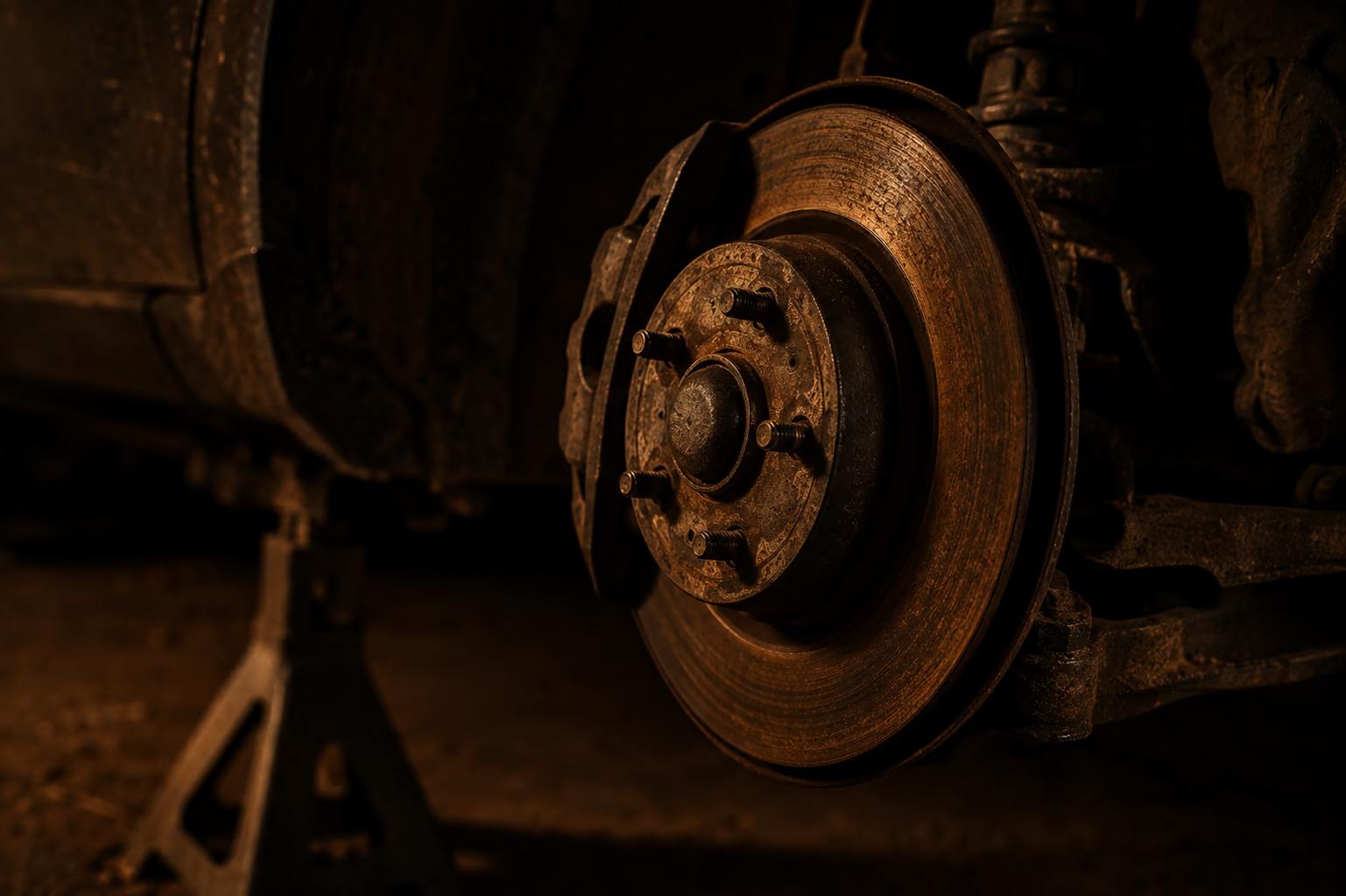
Confirming the car is safely supported is a statement about one moment in time. So the moment anything could have changed — you lower the car, you leave the app, the connection drops, or the job sits paused for a quarter of an hour — every open gate closes and gets asked again.
There is no partial reset and no “you already told me this five minutes ago”. Being asked twice costs you seconds. The alternative costs considerably more.
If the connection drops mid-job, your phone says so out loud without needing the network, because the worst moment to be met with silence is the one where you are waiting for the next instruction.
Jobs we will not talk you through
Some work is not safe to do hands-free and unsupervised, however competent you are. Cogged declines:
High-voltage packs
Opening or servicing a hybrid or EV battery, or work inside the orange cabling beyond a documented service plug isolation.
Airbags and pretensioners
Live pyrotechnic devices. These go off. There is no remote-guidance version of that going wrong.
Spring compression
Coil springs without a rated bench compressor store enough energy to kill from across a garage.
Structural work
Welding, brake line fabrication, or anything altering what holds the car together in a crash.
It says so in one sentence, without a lecture, and offers to help you get the car ready for someone with the right equipment.
Where you still carry the risk
Cogged is a guide. It cannot see your car, your tools, or your driveway. It does not know your jack is old, your ramps are on a slope, or that the bolt you are about to shear has been in there since 2009. It is not a substitute for the workshop manual, for the right equipment, or for a qualified technician — and on anything that carries someone’s life on it, a professional inspection is worth more than any amount of confident narration.
If you are ever unsure, stop. That is not a failure of the app or of you. It is the correct decision, and Cogged is designed to make it the easy one.